
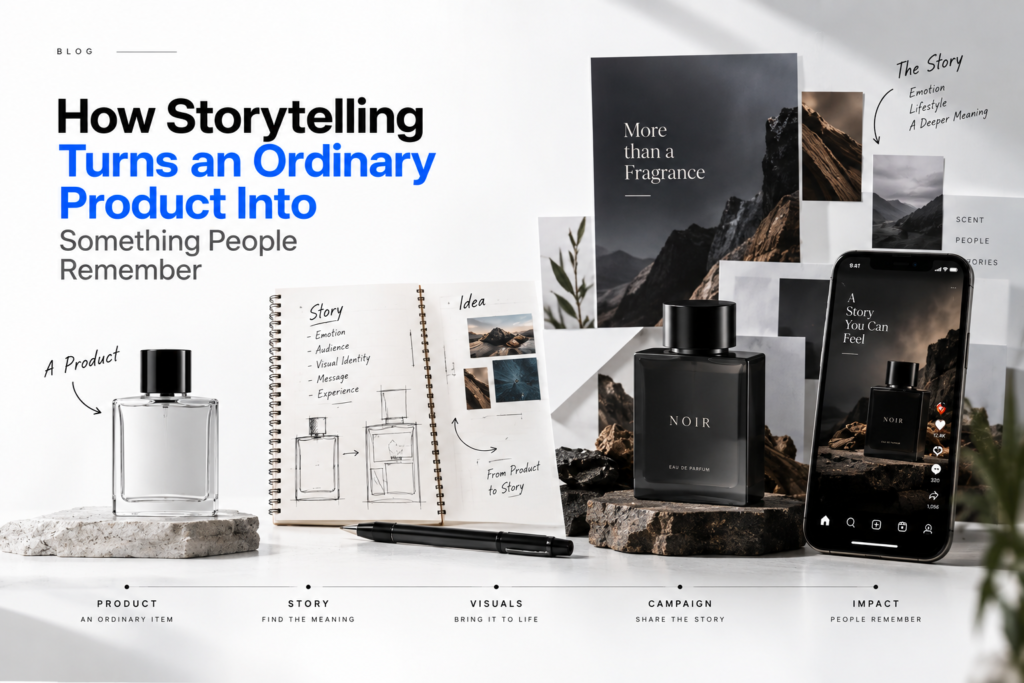
Selling a Good Product but Still Being Forgotten?
Think about the last time you bought something that was not the cheapest option.
Maybe it was coffee from a local café, a notebook from a small business, a pair of shoes, or skincare from a brand you found online. There was probably another option that did the same job for less money.
So why did you choose that one?
Most likely, it was not just the product.
Maybe the café made you feel like you were part of a neighbourhood. Maybe the notebook reminded you of starting fresh. Maybe the skincare brand spoke honestly about sensitive skin. Maybe the shoe brand made you feel confident before an important meeting.
That is storytelling at work.
The product may be ordinary. Coffee is coffee. A notebook is paper. A face wash is a face wash. But the story around it gives people a reason to care, remember, and choose.
For businesses, marketers, freelancers, and people building their careers, this matters more than ever. People see hundreds of ads and posts every day. If your message only says, “Buy this product,” it is easy to ignore.
A good story helps your product stay in someone’s mind after they stop scrolling.
Storytelling Is Not Making Things Up
When people hear the word storytelling, they sometimes imagine dramatic brand films, emotional music, and big budgets.
It does not have to be like that.
Storytelling simply means explaining your product in a way that connects with real people. It gives context to what you sell. It shows the problem, the person behind the business, the reason the product exists, and the change it can create.
For example, a bakery can say:
“We sell sourdough bread.”
That is clear, but it is forgettable.
Or it can say:
“We bake fresh sourdough every morning for people who miss the comfort of a proper breakfast.”
Now there is feeling behind it.
The bread is still bread. But the message gives people something to picture. It makes the product warmer, more human, and easier to remember.
From practical work in marketing, I have seen that people often spend too much time trying to sound impressive. They use big words, vague claims, and polished slogans. But customers usually respond better to simple, honest language.
Tell them why the product exists. Tell them who it is for. Tell them what everyday problem it solves.
That is enough to start.
Start With the Customer’s Real Life
The best product stories are not only about the business. They are about the customer.
Ask yourself: what is happening in their life before they find your product?
A busy parent may be trying to make healthier meals without spending hours cooking.
A young professional may be searching for clothes that make them feel confident at work.
A small business owner may be frustrated because they are posting online but not getting leads.
A student may want a simple way to stay organised during exams.
When you understand the situation, you can tell a story that feels familiar.
Instead of saying, “Our planner has premium pages and modern designs,” you could say, “For the person who starts every Monday with ten things to do and no idea where to begin.”
That is more relatable because it describes a real moment.
People do not buy products only for features. They buy because they want a better feeling, an easier process, more confidence, more time, or less stress.
Your storytelling should show that change.
Show the Journey, Not Just the Product
Every good story has movement. Something starts in one place and ends somewhere better.
Your product can be part of that journey.
For example:
Before using your service, the customer feels confused about marketing.
After working with you, they have a clear plan and more confidence.
Before buying your product, the customer struggles with dry skin.
After using it, they feel comfortable leaving the house without worrying about irritation.
Before joining your programme, the customer feels unfit and tired.
After a few months, they feel stronger and more energetic.
You do not need to make wild promises. In fact, honest stories work better.
Use real customer experiences, real reviews, real behind the scenes moments, and real examples of how your product fits into everyday life. This builds trust because people can see the difference you are talking about.
A customer testimonial is one of the simplest storytelling tools. Instead of only sharing five stars, share what changed for that person.
Social Media Starts the Story. Your Website Completes It.
Social media is a great place to get attention. A short video, customer story, product photo, or founder message can make people curious.
But curiosity needs somewhere to go.
This is why a website matters.
When someone clicks from your Instagram, LinkedIn, or ad, your website should continue the same story. If your campaign talks about helping busy business owners save time, your homepage should not feel unrelated or confusing.
It should make the message clearer.
Your website can explain:
What problem you solve
How your product or service works
Who it is made for
What makes it different
What customers say about it
How someone can buy, book, or contact you
That flow turns attention into trust.
A website is also valuable for freelancers and marketing aspirants. It acts as a portfolio where you can show your ideas, campaigns, writing samples, videos, designs, and case studies.
Recruiters often receive many resumes that look similar. A portfolio website gives them a chance to see your actual work. It shows that you can think beyond theory and present your ideas in a clear way.
Even if you are just starting out, you can include sample campaigns for brands you admire, personal projects, blog articles, social media concepts, or mock marketing strategies.
Keep Your Website Fast and Simple
A strong story can lose its impact if your website loads slowly.
Imagine seeing a video that speaks directly to your problem, clicking the link, and then waiting for the page to open. Most people will close it and move on.
Your website should feel quick and smooth.
Use properly sized images. Avoid adding too many large videos to one page. Keep animations limited. Use a clean layout instead of trying to fill every corner with information.
A fast website makes your business feel more reliable. It also helps visitors get to the important part quickly: understanding what you offer.
A simple website does not mean a boring website. It means every section has a purpose.
Make Sure the Story Works on Mobile
Most customers will meet your brand on their phone.
They may see your reel while sitting in traffic, find your product through a Google search, or click a link someone sent on WhatsApp. If your website is difficult to read or use on a phone, you are creating a problem before the customer even learns about your offer.
Mobile optimisation means making sure your website works well on smaller screens.
The text should be easy to read. Buttons should be easy to tap. Product images should load properly. Forms should be short. Contact information should be easy to find.
Test your website on your own phone. If you have to pinch, zoom, or search around to find basic details, your visitors will feel the same frustration.
Good User Experience Makes People Stay
User experience is simply the feeling people get while using your website.
Do they know where to click next?
Can they find what they need quickly?
Do the pages feel clear and organised?
Can they contact you without effort?
If the answer is yes, you are already doing a lot right.
Use clear headings. Keep your menu simple. Add enough space between sections. Use real images where possible. Put clear buttons in the right places.
For a digital marketer freelancer in dubai, this can be the difference between a visitor leaving and a visitor booking a call. A potential client should quickly see what services you offer, proof of your work, client feedback, and a direct way to reach you.
The easier you make the experience, the more professional your brand feels.
Make Your Product Mean Something
Storytelling does not turn an average product into magic. Your product still needs to be useful, honest, and well made.
But when you connect it to a real human need, memory, challenge, or dream, people see more than the item itself.
They see the role it can play in their lives.
Start with the customer’s world. Show the problem they face. Explain how your product helps. Use your social content to catch attention and your website to build trust. Keep the website fast, mobile friendly, and easy to use.
That is how an ordinary product becomes something people remember.
Follow anshidnasim.com for more practical updates on storytelling, digital marketing, personal branding, and building a business people want to come back to.