
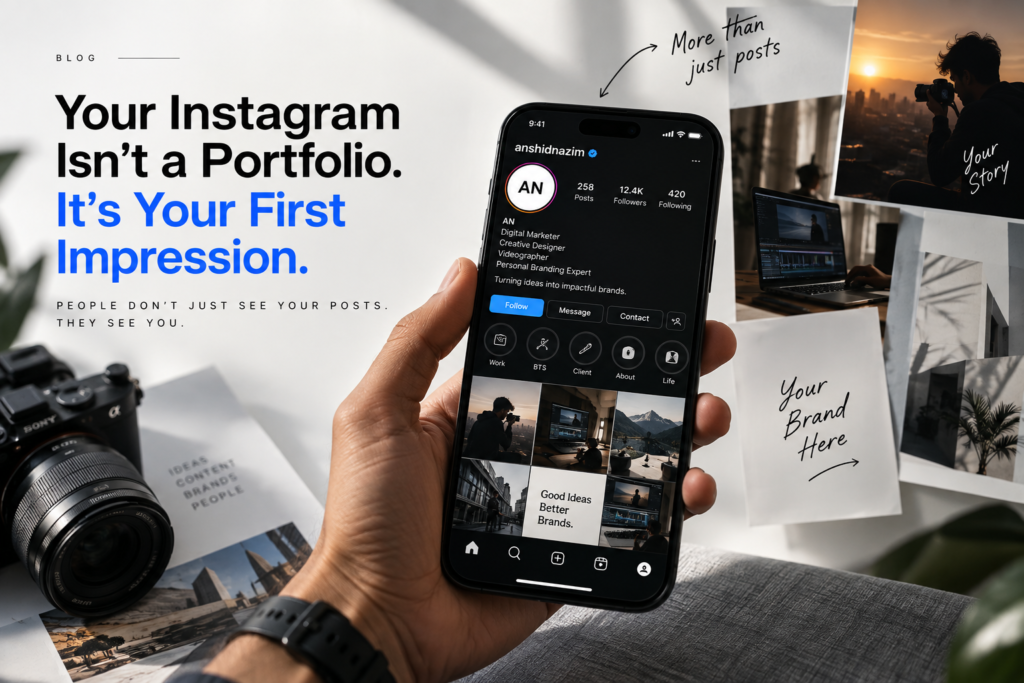
You meet a potential client at an event, a recruiter messages you on LinkedIn, or someone hears about your work through a friend. They are interested. They want to know what you do, who you have helped, and whether you are the right person for the job.
So, they ask for your portfolio.
You send them your Instagram handle.
They open your profile and start scrolling through reels, memes, personal posts, old promotions, random stories, and a few good pieces of work buried somewhere between them. After 30 seconds, they are still unsure what exactly you offer.
That is the problem.
Instagram is great for visibility. It helps people discover you, see your personality, and stay connected with your work. But it is not a portfolio. It was never built to clearly present your services, your results, your process, or your credibility.
If you are a business owner, freelancer, marketing aspirant, recruiter, or entrepreneur, having only an Instagram page can quietly cost you opportunities.
Instagram Gets Attention. A Website Builds Trust.
Think of Instagram as the street outside your shop. People walk by, notice your display, and may step in for a quick look.
Your website is the actual shop.
It gives people a clear place to understand your work without distractions. No competing reels. No algorithm deciding whether your post gets seen. No need for someone to scroll endlessly to find one case study from six months ago.
A website lets you control the first impression.
You can tell visitors:
Who you are
What you do
Who you work with
What results you have delivered
How they can contact or hire you
That clarity matters more than most people realize.
When someone lands on your website, they should not have to guess whether you are a social media manager, performance marketer, designer, agency owner, content writer, or job seeker. They should understand it within seconds.
That is what a good portfolio website does. It makes your value easy to see.
Your Work Deserves More Than a Grid
Instagram content moves fast. A post you spent hours creating can disappear from people’s feeds within a day. Even your best work gets pushed down by newer content.
A website gives your best work a permanent home.
For example, instead of posting a graphic saying, “We increased reach by 200%,” you can build a proper case study on your website. You can explain the client’s problem, your strategy, the content or campaign you created, and the final result.
That tells a much stronger story.
As someone who has worked around marketing portfolios and client decisions, I have seen this again and again: people trust proof when it is presented clearly. Screenshots, testimonials, campaign results, before-and-after examples, and detailed case studies make it easier for someone to say yes.
This is especially useful if you are a marketing aspirant looking for a job. Recruiters do not only want to see that you know how to make an Instagram post. They want to see how you think.
A website can show your sample campaigns, ad creatives, email ideas, SEO work, writing samples, and personal projects in one organized place. Even if you are early in your career, your website can show your effort, skills, and point of view.
That can set you apart from another candidate who only sends a resume and an Instagram link.
A Website Makes You Look Ready
You do not need a huge agency, a fancy office, or 10 years of experience to have a professional website.
You just need a simple, clean space that represents your work well.
A strong website can have just a few pages:
Home page
A clear introduction to who you are and what problem you solve.About page
Your story, background, experience, and approach.Services page
A simple breakdown of what you offer and who it is for.Portfolio or case studies page
Your best work, results, client stories, and samples.Contact page
A clear way for people to get in touch.
That is enough to get started.
Many people wait because they think building a website has to be expensive or complicated. It does not. There are plenty of tools that make it possible to launch a clean site without knowing how to code.
The important thing is not having the fanciest design. It is making it easy for visitors to understand you and take action.
Speed Matters More Than You Think
Have you ever clicked on a website that took forever to load?
You probably left.
Your audience does the same.
A slow website can make people lose interest before they even see your work. It can also hurt your chances of showing up on Google. Search engines prefer websites that load quickly because people prefer them too.
Keep your website fast by using compressed images, avoiding too many heavy videos, and choosing a reliable website platform or hosting provider. You do not need every animation, pop-up, and moving element on the screen.
Simple usually works better.
Your website should feel smooth and easy, especially for someone who is visiting for the first time. If it takes too long to load, they may never get the chance to see how good your work is.
Most People Will Visit From Their Phone
This part is non-negotiable.
Your website needs to work properly on mobile.
Most people will find you through their phone, especially if they come from Instagram, LinkedIn, WhatsApp, or a Google search. If your text is tiny, buttons are hard to click, or images look broken on mobile, you are creating friction for the visitor.
Check your website on your own phone before sharing it. Ask yourself:
Can I understand what this person does quickly?
Can I see the portfolio without zooming in?
Can I contact them in one or two clicks?
If the answer is no, fix it.
A mobile-friendly website is not just about appearance. It makes it easier for people to take the next step.
Good User Experience Helps People Say Yes
User experience simply means how easy and pleasant your website feels to use.
You do not need to overthink it.
Use clear headings. Keep the menu simple. Add enough white space. Use readable fonts. Make your contact button visible. Do not make visitors work hard to find basic information.
If someone wants to hire you, they should not need to search through five pages to find your email address.
If a recruiter wants to see your work, your portfolio should be easy to find.
If a business owner wants to know your pricing or service process, give them a clear next step.
Good user experience shows respect for people’s time. It also makes you look more professional and prepared.
Instagram Should Support Your Website
This does not mean you should stop using Instagram.
Use it well.
Share behind-the-scenes moments, quick tips, client wins, opinions, reels, and personality-driven content. Let people discover you there. Then guide serious leads to your website.
Your Instagram bio should include your website link. Your content can point people toward a case study, service page, lead magnet, or portfolio section.
For example, if you are a digital marketer freelancer in dubai, Instagram can help you reach local business owners and build familiarity. Your website can then turn that attention into inquiries by showing your services, past work, testimonials, and contact details.
That is a much stronger system than relying on one social platform alone.
Final Thoughts
Instagram can help you get noticed. But a website helps people trust you, understand you, and hire you.
Your website is where your work gets the space it deserves. It is where businesses can see your services, recruiters can review your skills, and potential clients can make a confident decision.
Do not wait until everything feels perfect. Start with one simple website, your strongest work, and a clear message.
Follow anshidnasim.com for more practical updates on building your personal brand, portfolio, and digital presence.